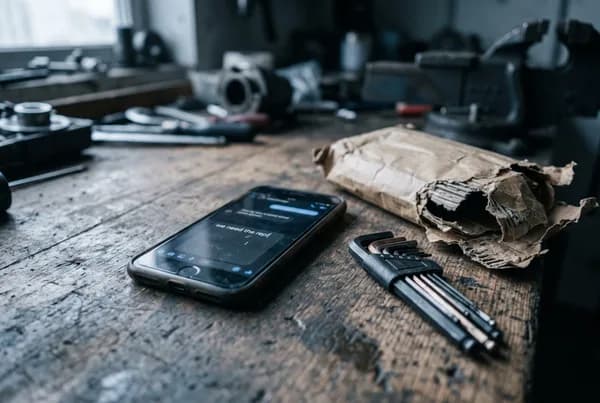
I wrote a message to a bloke I have known for eleven years, asking whether he could give me two hours on a Saturday to help get a shed frame up. Then I did not send it. I redrafted it on the Tuesday, took out the word sorry, put it back on the Wednesday, and on the Thursday I paid a man with a nail gun two hundred and forty dollars.
The shed took three hours. The message was seventeen words. I spent four days on the seventeen words and none at all on the shed.
That is the shape of it, and it took me an embarrassingly long time to see properly. The difficulty is in the asking, not in the thing asked. Nobody is deliberating for four days over two hours of a Saturday. You are deliberating over a sentence.
The opening line carries most of the cost
There is a neat piece of evidence for this, and it holds up even though it was run on strangers rather than mates.
In a 2021 paper in the Journal of Experimental Psychology: General, Juliana Schroeder, Donald Lyons and Nicholas Epley asked 148 participants to rate the parts of a conversation with a stranger. Starting one was rated harder (mean 3.43) than ending one (mean 2.53), a difference of d = .49. In the same work, imagining trying to have the conversation was rated less positively (mean .48) than imagining having succeeded at it (mean 1.00), d = .43. The paper is here.
So the dread attaches to the act of initiating and to the attempt, rather than to the encounter itself. My four days were spent entirely on the part that would have taken nine seconds.
What you are actually rehearsing
Underneath the redrafting is a specific picture of being knocked back, so it is worth seeing what happens when researchers test that picture in the field.
Epley and Schroeder, in a 2014 paper in the same journal, sent commuters onto trains with instructions to strike up a conversation. Read the result for what it is: not a single person reported being rebuffed. The seven who could not complete the task said nobody had sat next to them. The authors put it plainly - commuters appeared to think that talking to a stranger posed a meaningful risk of social rejection, and as far as they could tell it posed no risk at all. The paper is here.
The same experiment recorded how those conversations went, which I have left out here because what matters for asking a mate is the rejection count, and it was zero.
A commuter on a train is not a mate you have not seen since 2019, and the two situations are not the same. What transfers is the direction and the size of the error. The refusal you are bracing against is a prediction, and predictions here run pessimistic.
Ask straight
This is the part I would keep if you kept nothing else, because it contradicts the obvious advice.
Vanessa Bohns, reviewing this literature in Current Directions in Psychological Science across a body of studies covering many thousands of participants, reports that people asking for something underestimate compliance by an average of 48 per cent. The review is here. The mechanism she proposes is that we fail to appreciate how uncomfortable it is for the other person to say no. Refusing somebody is itself an awkward act, so the awkwardness you are trying to avoid mostly sits on his side of the table.
One study inside that literature, Flynn and Lake in 2008, found people were more likely to comply with a direct request than with an indirect hint, and that the requesters expected the opposite. That is a single study rather than settled consensus, so hold it loosely. But it points against the thing most of us actually do, which is hint. "We should get something in the diary at some point" is the hint. "Saturday morning, two hours, can you give me a hand with the shed" is the request.
I have seen it claimed that a softener like "no worries if not" halves your response rate. I went looking for the study behind that and could not find one. So I will say only what is supported: one experiment found direct beat indirect. If the softener is what gets the message sent, keep it, and do not let anybody quote you a price for it.
Worth stating plainly, since almost everything I write is about men: Bohns reports no reliable gender effects across this literature. The reluctance to ask is human. Men may get less practice at it, which is a different problem.
Shrinking the ask does not buy you a yes
I spent a year believing the opposite, trimming my requests until they barely asked for anything.
The same review reports that request size did not predict compliance across the studies it covers. Targets found it about equally hard to refuse a one-page questionnaire and a ten-page one. So the standard advice, keep it small so it is easy to accept, does not have the evidence behind it that people assume.
There is still a good reason to keep an ask bounded, and it is a different one. A bounded ask is answerable. "Saturday, two hours, back by lunch" can be said yes or no to in four seconds. "Do you want to catch up properly sometime" cannot be answered at all, so it does not get answered. Bound it for clarity, and do not water down what you actually want in the belief that a smaller version lands better.
The medium you judge worst
Bohns also reports that the accuracy of these predictions depends on how the asking is done. People asking face to face underestimate compliance. People asking through flyers and email overestimate it.
Text messaging is not one of the studied media and I am not going to claim it is. But it sits on the far side of that line, away from the other person's face, and the error flips direction there. Two things follow. The ask you dread most, the one in person, is where your read is most wrong. And when a message goes unanswered, the medium is a better first explanation than the man is.
What a no is worth
Newark, Flynn and Bohns, in Social Psychological and Personality Science in 2014, tested what happens when you ask again after being turned down. Requesters expected compliance to fall by 16 per cent after an initial refusal. It rose by 10 per cent.
That fits the mechanism. A man who has refused you once is carrying the discomfort of it, and the second ask gives him somewhere to put it.
I have no rule for how many times to try, and I would be suspicious of anybody who offers you one, because there is no number in the literature that supports it. What the finding does rule out is the usual response, which is to treat one no as a verdict on the friendship and go quiet for a year.
The mate you have drifted from
This is the case the research is sharpest on, and the one this site is about.
Liu, Rim, Min and Min ran 13 preregistered studies on getting back in touch, published in the Journal of Personality and Social Psychology. In one, they matched 54 real pairs of sender and recipient: senders predicted the message would be appreciated at 5.57, and recipients reported 6.17, a gap of d_z = .34. More usefully, the underestimation was four to five times larger for weak ties than for close ones (.046 against .010). The paper is here.
A bloke you have not spoken to in three years is the weak-tie case by definition. Your estimate of how welcome the message will be is at its least accurate precisely where you are most reluctant to send it. If you want the mechanics of how those friendships went quiet in the first place, I have written about the drift, and the move from acquaintance to friend is here.
Reading this will not make you send it
The ceiling on an article like this one was measured by the same research team.
In a supplemental study of 118 people, Liu and colleagues told participants about these findings and then looked at whether they got in touch with anybody. Interest in doing so trended upwards but not significantly, and there was no significant increase in what people actually did. Being told the yes rate is higher than you think does not reliably produce a message.
I do not find that discouraging so much as clarifying. The evidence is the easy half. The seventeen words are the part that does anything, which is why I would rather end on those.
This week
Open your messages now, while this is still in front of you, and write one to a man you like. Give it a day, a thing and a duration: Saturday morning, help me shift a wardrobe, an hour tops. Do not explain why you are asking, do not mention how long it has been, and do not apologise.
Send it before you redraft it a third time. If he says no, the research says the next one is not worse for it. The alternative is four days of drafting and two hundred and forty dollars.
Sources
- Epley N, Schroeder J. Mistakenly seeking solitude. Journal of Experimental Psychology: General, 2014. Commuters on trains and buses randomly assigned to connect or to sit in solitude; in Experiment 1a not one participant reported being rebuffed, and the seven unable to complete the task reported that nobody sat next to them. https://faculty.haas.berkeley.edu/jschroeder/Publications/Epley&Schroeder2014.pdf
- Bohns VK. (Mis)Understanding our influence over others: a review of the underestimated-compliance effect. Current Directions in Psychological Science. Review across a large body of request studies; reports no reliable gender effects. https://doi.org/10.1177/0963721415628011
- Flynn FJ, Lake VKB. If you need help, just ask: underestimating compliance with direct requests for help. Journal of Personality and Social Psychology, 2008. Direct requests complied with more often than indirect hints, against requesters' expectations. https://doi.org/10.1037/0022-3514.95.1.128
- Newark DA, Flynn FJ, Bohns VK. Once bitten, twice shy: the effect of a past refusal on expectations of future compliance. Social Psychological and Personality Science, 2014. Requesters expected compliance to fall after an initial refusal; it rose. https://doi.org/10.1177/1948550613490967